62  
sufi retreat centre    
line decor
  SUFI HOME
line decor


sufi material

dates dances walks khanqah essays


Links

Websites offering a rich source of traditional and modern interpretations of Sufism

Sufi Order of the West Headed by Pir Zia Khan
Sufi Ruhaniat International  Headed by Pir Shabda Khan
Diamond Approach
 
A. H. Almaas, a Sufi based psychology
Sufi Healing Order
Zenith Institute
Sufi summer camp in the Alps led by Pir Zia and others
Suluk Academy
School offering teachings of Hazrat Pir-o-Murshid Inayat Khan.
Sufi Movement
Nur Ashki Jerrahi Sufi Order
Community of dervishes based at Masjid al-Farah in NYC
Saki Lee Sufi classes and retreats. Sacred music and Dance. Healing Arts.


Dates for Events


2008
Jemal Group
Sept 17 - 21
Kemal Group
Oct   22 - 26
 
2009
Kemal Group
April 15 - 19
Unicorn Retreat
May 6 - 10
Jemal Group
June 3 - 7
Contact:

Top


Essays for Students of Sufism

Some of the material is original, yet often the ideas are simply from other sources and summarized in a slightly different form. Apologies are offered for any omissions in acknowledgements and any misunderstandings.

Adab – Right Manner
Attention
Belief
Clarity
Die before you Die
Energy, Mood and Perception
Entertainer, Teacher, Priest
Faith
Group Process
I Wonder
Incarnation
Love is Universal Glue
More stinking from thinking...
Mysticism, Miracle and Authority
Openness
Perception
Sound and Tone Magic
Salt Puppet
Spiritual Journey
Soul and Ego
Truth
Transition
Wisdom
Worship

Top


Dances of Universal Peace and Sufi Chants

Free Downloads in pdf format (up to 30 seconds)

AlhamdullilahTauhara      Alhamdulillah     Allah7     Allahu El Allahu     Alleluia 2000
Allah Allah Allah Hu     All Hallows Eve      Al Qulub      Archangels     Allah Hakim
Allah Ishq Hu     Allah Allah Ishq Hu     Baruch Ata      Beauchamp Zikr    Ya Baha
Bismillah 2001      Bismillah 2002      Estaferrullah     Flying Bird     Flower
Fires of Beltane     Gate     Go Placidly      Hare Krisna      Heart of Heroes
Ishq Petals     Jamil in 3 parts     Khanqah Zikr     Khanqah Bismillah      Love Lover Beloved
Let the Wave Break     Lakshmi     Mashallah     Minsk Bismillah     Mutakabbir
Minsk Zikr      Merrymeet     Murakkaba     Majid Mawjud     Nayaz
Nimatullah     Night Zikr      New Moon Zikr      Nabi al Rahman      Om Mani Peme Hung
Petersburg Zikr     Rabb al Mala'ika     Riga Zikr     Song of Being      Shema Israel
Sebastopol Estaferrullah     Subhan Tauhara      Troubadour Song      Tallinn Bismillah     Vasudevaya
Voice of Bard      Wise Earth      While the Earth Remains     Ya Allah Ya Allah     Ya Hadi Ya Qayyum
Dhull Jelal wal Ikram
101 Tips for Dance Leaders

Top


Wazifa Walks

The “meaning” of a wazifa is not an absolute. We employ wazifas to tune into one of God’s qualities – and these qualities are not absolute either. It’s helpful to allow that the spoken word of a wazifa is the form of it – yet it has essence too and it is the essence that we seek to embody so that some of its quality can rub off onto us. See them as angels of God (angles of God if you prefer), even archangels in certain cases, and that they are self-aware highly conscious living beings who are able and willing to respond when called by name in the appropriate way. Nor are they simple – they have characteristics, much as the Hindu gods have aspects tendencies that point towards their essential symbolism. So we can use a wazifa for different purposes; some are quite versatile and are used for awakening any one of several of the chakras (Quddus perhaps) while others are almost always used for one only because their meaning is less obviously subject to a wide interpretation.

These walks are also interpretations – and subject to further creative interpretation by future students. There are melodies and body prayers that go a long way towards ‘anchoring’ ones interpretation into a body memory that is quickly remembered upon subsequent revisiting. The melody alone, remembered even silently, will create within the physical and emotional bodies a tendency to realign in order better to express the wazifa’s inherent quality or qualities. In some cases – Matin, Aziz, Malik say- the attunement is less refined than in others – Nur, Quddus, Wakil; this is not necessarily because those wazifas are more gross in general sense; it’s just the way they have been accessed for the purpose of the walks.

Each of us has each of the qualities of each of the wazifas available as an aspect of our potential personality, yet few of us have mastered even one, to its fullest depth. By taking the challenge of learning how to really embody these archetypes we are expanding our repertoire of creative possibility to shine more radiantly the glory of God in diversity. Notice your response to them – as spoken practices, as melodies and as walks, and by this you will gain a more subtle awareness of yourself – the glories as well as the faults.

Wazifas – or in Arabic wazaif – are also known as the 99 Names or the Beautiful Names of God. We, each one of us, are also to be counted as one of the Beautiful Names of God – though there may be billions – and each one of us can work to perfect unity’s expression through us.

Not all of the movements are original – some have been passed down from students of Samuel Lewis and his successors in this work and the author gratefully acknowledges their input and inspiration.

Here are some walks with melodies suitable for dynamic meditations

Free Downloads in pdf format (up to 30 seconds):
Alim Aziz Basit Darr Fazl Haqq Hayy Hadi Halim Hakim Inayat
Jamil Jabbar Jami Khaliq Karim Khabir Khalil Latif Matin Majid Mu'min
Mansur Mumit Mujib Muhyi Muhaymin Mu'id Malik Nur Qahhar Quddus Qadr
Rahim Rashid Sabur Salaam Subhan Allah Wakil Dhull Jelal Wal Ikram Wasi


Top


Khanqah Salaam


Surely Sufism has true worth only if workable as a medium of promoting spiritual values in the "real" world. The test of this is in the community in which one lives and works.

jb

21


As a way of carrying Sufi practice into a way of life an experiment is underway in Lithuania. A house has been acquired with meadow and small surrounding woodland and is focus for the local Sufi group who are managing events such as retreats, camps and workshops for students of Sufism, healing, DUP and such pursuits. There are possibilities to visit these events and in certain cases do individual retreats at the retreat house, Khanqah Salaam.

A khanqah is a house dedicated to Sufi community. Each room must have an altar; one room is specially allocated to accommodate guests, another to prayer. The whole khanqah is to serve God and its design reflects this. One lives out life there with children, work and play as with all life - yet always in proximity to the One.

32

46

Khanqah Salaam is young and finding its way. All decisions are made collectively by the local group with some consultation with the guide. Some of the events that are run here are not Sufi as long as they are in harmony with the evolving ethos. For example as well as Sufi retreats, a Heaing camp and a children's DUP camp have been held so far. Working together on such a project is very useful as a way of integrating the teachings into normal life.


Top


Essays


Attention

Each of us perceived the reality of Life in a unique way according to various factors - what we have previously perceived, what we want, what we fear, what we expect. These factors are forms of thought and emotion and thought and emotion are as mutually connected as the depth and surface of a river. What is "real" for us inside becomes real for us outside so that physicality cements our more subtle reality into hard fact. That process of becoming real is worth consideration.

Attention given and received is what motivates the transition of astral reality into materiality. If attention is given to another is sufficient measure there must be a response - perhaps attraction, perhaps repulsion yet certainly an expression of preference with emotional currents. Thus atoms, animals, people and planets create bonds, which for a time bind together a form, a material reality. The absence of this bonding is chaos - absolute formlessness.

We become a reflection of what we have focused our attention on. We choose our lives in this way by focusing on security, sex, money, prestige, TV, food, music or prayer in some dynamic combination. The face, the body, the mind and heart all show clear proof of the history of where we have focused our attention throughout life. Perhaps a gardener is more patient than an artist who is more appreciative of beauty than an accountant who is clearer minded than a drug addict who is more liberal than a gardener. Yet one person can experience all of these attitudes during one lifetime and gain a width and depth of understanding.

What is real is only real because a number of separate entities (atoms, people, etc) have joined together in a way that acts out an inherent energy field. These fields of energy are astral realities: zeitgeist, ethos, vision, hopes, dreams, fashion, fantasies, corporate image, national pride and so on (these are Neptune's forms). Without creating one of these first, nothing physical can manifest. First the idea then the reality.

A person - the person, who exactly finds words to capture the Neptunian form becomes the spokesperson for that reality and by speaking it apparently creates it. Indeed that is how it is created - by the word of this spokesperson. Historical figures, pop stars, inventors, film stars, TV newsreaders (with their carefully manicured voices) all become icons of the age because they give voice to the idea that is yearning to come into material reality.

So spiritual persons are careful to develop their astral reality out of optimism and devotion to God. They choose carefully how to allocate attention and indeed to respond indifferently to attention from unwanted sources.

Back to Essays List


Perception

In the early days of life, the boundaries of self are not strong and external atmospheres and pressures mould each of us. As years go by, individual malleability is reduced and the psyche crystallizes into a personality that reflects our most frequent and most intense experiences. We can see from this that our neuroses and our character are shaped by the same forces, and in fact are aspects of each other.

Perception depends entirely upon these crystallized patterns of energy and one would place them in the Solar Plexus. Here is the membrane that is sensitive to all sensory input, and it is sensory input that activates perception. This question of the membrane's sensitivity is all-important since the form taken by the membrane creates what we think of as external reality. Negatively, sensitivity can be seen as the speed of the ego's reactive (neurotic) nature; positively, it can be seen as the more subtle and fuller awareness of our immediate surroundings. The membrane's correct functioning depends upon a relaxed and fluid emotional nature since intense or fixed emotions corrupt its subtle sensitivities.

One seeks a state of sensitive indifference, which can be developed with breathing practices and concentration of mind. Careful to mute our responses to outside stimuli, one is unattached to any emotional expression, yet very aware of inner feelings and able to employ emotion as an added dimension of communication and relationship.

Look within, breathe light in and out through the Solar Plexus, become one with that light until all distinctions dissolve in a field of light. Relax your world-view; see how it is light that connects. It is light that connects. Stand back from yourself and look at who you are, be aware of the parts never shown, let them breathe at last, let them relax and influence your responses and your choices. Be not ashamed of whom you are, celebrate the best and be open and humble about the rest.

Back to Essays List


Belief

Consider the source of one's beliefs. Consider also the process of forming belief out of ideas. One can easily acknowledge that an individual is influenced by others, often those having a strong emotional impact especially in earlier years. One is also moved by well-reasoned writings or exciting images which appeal to ones imagination.

Is it clear that belief is formed by subjective processes of mind? Our beliefs reflect our hopes and fears, our emotional bonds, our need and wants and only in some cases could we truly say that belief is impeccably reasonable. If then create our image of God out of belief are we seeing anything more than a simple reflection of ourselves?

As mysticism and science grow closer and closer together one can more easily see how very little of the phenomenal world is fixed by universal laws. Also if one studies human behaviour in different countries at different periods one can see almost any behaviour, opinion or attitude of morality can be acceptable to someone at sometime.

If belief is not a trustworthy indicator of God then what is?
What is actually truly knowable?

It is not required that we believe in God, it may even be said that such belief is an unnecessary limitation. Belief is a construct of Mind, "belief in God" is a god, a lesser form and therefore not true. It will be useful for the early stages of development to hold onto belief as a helpful tool towards knowledge and yet one must throw away the crutch of belief if one is truly to walk in knowledge.

Back to Essays List

sufi


Energy, Mood and Perception

Energy is the capacity to do work. It is variable from one person to another and from one day to another. Mental energy enables one to do mental work, physical energy gives strength to do physical work. We can also consider emotional energy and other forms. Power and robust good health show high levels of energy.

Mood relates primarily to feelings and is also variable from day to day and person to person. Mood communicates in subtle ways and yet is all-pervasive within a given group. Indeed, there is the idea of the universal world-mood of a particular moment in history (called in German the zeitgeist or time-spirit). Individually one's mood can change quickly or slowly and be more or less influenced by many factors including weather changes, personal expectations, sexual questions and more.

Perception is an inner quality of consciousness. Sensory data touches upon the physical body and stimulates impulses within and then they are grouped together to form a graspable item of awareness. Thus are created the building blocks of our individual reality systems.

Does mood affect energy? Does energy effect perception? Does perception affect mood…? Yes of course they do, if fact we can say that these three qualities are inter-related. Boundless energy, absolute awareness and ecstasy are all found in a truly advanced being while depression, dim-mindedness and sluggishness are seen in less-developed types.

Back to Essays List


Love is Universal Glue

We have thought of love as the force of attraction and yet we can go more deeply into this question to see beneath attraction and repulsion. Love can be seen as the resultant force arising out of cause and effect. Very often entities are mutually attracted by a force that cannot bind them together for a long time because there is an inherent instability that eventually turns attraction into repulsion, a force that turns fusion into fission, often typified by a cathartic implosion. This shows that attraction can take place without love.

Perhaps we can see that love underlies attraction and yet is not attraction itself. It fuses male and female together, merging towards unity what was previously separated. It is described as the glue of the universe. Love gets things to stick together. It is a creative and pleasant force that creates oneness out of separation.

As an atomic reality, the vibrational function of love is to absorb, convert, fuse and unify. This glue is absorbing; love merges two beings towards a state of oneness. The urge to be "in love" is the urge to be absorbed and fused with another so that the pain of a life of loneliness and isolation ends. Love can develop as a result of male/female bonding or can develop separately within an individual who is ready to experience this fundamental life condition.

When Love operates through a woman, this generates a holding space for new forms of spirit and thus attracts the fulfillment of her potential, as a child or as a relationship or as a creative art form for example. Operating through a man, Love seeks to fertilize the potential of the feminine and directs matter to open up and reform itself.

Various forms of expression are known to us, for example: Physical love is not only sexual; it includes the sense of well-being that is felt by person whose family, especially the mother, is nearby. Emotional rapport, described as empathy and is a stage of opening the heart. A kind of sympathy that relates more to the mental plane indicates a sense of readiness to accept the ideas and beliefs of another. Compassion is love in action and is unattached to results. We can share a spiritual love with a teacher who is able to awaken God consciousness in us.

Back to Essays List


Entertainer, Teacher, Priest

What is our purpose as dance leaders?

Dances of Universal Peace are employed to achieve a number of quite different outcomes so it is worthwhile to acknowledge this and to focus more keenly on what we may see as our own particular intention as leaders. Indeed this intention may change over time and from time to time so the questions may be subtler than we may at first perceive. The dances have been used for these and other purposes:

  1. to offer ‘drug-free highs’ to hippies
  2. to help teach people to walk better
  3. to praise God
  4. as light relief during meditation retreats
  5. as the central focus of a meditation retreat
  6. to celebrate a special season of the year
  7. as part of a wedding celebration
  8. as part of a commemoration of a departed beloved
  9. to achieve particular Sufi states
  10. to renew our spiritual devotion
  11. to impart wisdom
  12. as an icebreaker …… and so on.

Our choice of what dances to offer will reflect the purpose we have and how to achieve that purpose, also where we are and when. A jolly vernacular partner dance is not always interchangeable with a profound zikr – almost never in fact – so how do we equip ourselves to decide what to present? Well, we can develop a repertoire that is broad enough to meet a range of circumstances and yet also is particular to our needs. We also hone our skills as leaders to meet a given situation – for example someone working with special needs children will be more likely to learn to let go of expectations and enjoy the process itself; one whose local group rarely exceeds six in number may not be concerned with how to make her guitar sound louder; another who works with prison inmates may be more interested in anticipating and circumventing outbreaks of violent abuse than whether the dancers hold hands (let alone in the manner prescribed).

As the heading suggests, one can divide the leader’s task into 3 archetypal roles: entertainer, teacher and priest. Is it controversial to admit that we are entertainers? Alas, the (western) world has become a place where consumers want and need to have their appetites fed and (perhaps unconsciously prioritise their life choices in order to meet these requirements). Our dancers have needs – for social contact, for attention, for recognition and for distraction. Even if we have no such intention, we nevertheless do entertain. We offer popular dances, we offer pleasure, we stimulate joyful feelings and ask for very little in return. So be it; perhaps we can accept that we have a certain social role as entertainers – and without the ability to entertain we would not be so likely to have a circle to teach…

… and what do we teach? Apart from the technical aspects of the dances: words, melody and movements – what else? Samuel Lewis did actually have the intention to “teach them to walk properly” and also to promote Hazrat Inayat Khan’s message of universality of worship that he so ably embodied. Most certain SAM had a clear sense of passing on knowledge – and taught a range of dances that served his purpose. One can observe that SAM’s dances are never sentimental, often require a high degree of concentration and generally lift the dancers to an altered consciousness. Such cannot be said of all the dances in our repertoires. Is this OK? Perhaps it is since we have different purposes now, which purposes are indeed better served by dances more melodic, sometimes sentimental and often undemanding. Perhaps a dilution has taken place - due to the spreading out - and this is to be acceptable as inevitable and possibly efficacious. Whatever; let the dances carry our teachings! Our teachings, not SAM’s and not our mentor’s. We have to take full responsibility for what we are teaching.

If it shocks us a little to be confronted with the fact that we are the teachers and ours are teachings, then there may be an even greater discomfort felt when we affirm that we are priests/priestesses too. We have a sacred duty and privilege to be an agency through which our dancers are empowered to reach out their hearts in yearning for God. Without us, perhaps they may not have the courage, the clarity, the energy, the knowledge how to do so. Wouldn’t we willingly risk suffering abuse from those who question our methods in order to help just one  person take one step closer to the Beloved?

All in all we have surely to acknowledge that we are far more than Sufi Sam’s spiritual grandchildren, trying so hard to master the legacy of his teachings. We, ourselves, are ancestors to those who follow us and have to claim our own spiritual authority in the same way Samuel Lewis had to, so that we can further the work in our own way - our own way - in our own field of interest and location. The time has come for the thousands and tens of thousands metaphorically to put on their priestly robes and speak of God without the straitjacket of religious dogma or the abuses of hierarchy interfering with the existential privilege/duty each of us has to represent the unfolding of Divine wisdom.

Back to Essays List

Samuel Lewis
Samuel Lewis by Vitalija


"More stinking from thinking..."

It is typical of a spiritual movement to arise and develop in response to a perceived need or in reaction to a perceived wrong. Mohammed identified an error in the worship by his countrymen of many gods and proclaimed the essential tenet of Islam: None save Allah!; Christ taught ‘turn the other cheek’ instead of the ‘eye for an eye’ doctrine taught at that time. Buddha spoke in favour of more equality than was given by the caste system of his homeland. Without knowing the circumstances that threw up a new ideology we are unable to put it in proper context.

So - in what context shall we put the up swelling of the Dances of Universal Peace phenomenon? It is not alone. During the same era, the western world has seen many new forms and new presentations of established systems in the areas of personal growth, healing and spiritual expression. The time was ripe for an easily-accessed method through which the student could joyfully discover some of the mysteries of the ages. A few years earlier would have been to early - there were no hippies and no widespread thirst for esoteric knowledge and heart-centred involvement with strangers.  DUP arose in San Francisco in the ‘60’s within a year or two of Woodstock – and its founder two generations older than most of his students, died within a few years having taught (by today’s standards) relatively few dances for a relatively short period. [He would have a hard time meeting the certification standards at level I. – And never at level II !]

By all accounts Murshid Sam was a Uranian type – brilliant wit, eccentric, energetic, revolutionary and free – in other words he could out -hippy the hippies in many ways. A friend of his – Joe Miller – was somewhat similar and is quoted as saying “you get more stinking from thinking than you can from drinking.  To feel is for REAL !”. It was an age of cleverness, esoteric cleverness, and these two San Francisco elders were trying to bring back youngsters to a feeling body-awareness. Although we still have much to learn about how to how to concentrate the monkey-mind and allow the heart to make more impact upon our decision processes, the typical dancer of the 21st century is of quite a different category to Murshid Sam’s students: more likely to be a meditating professional than a spaced-out youngster on dope, and quite capable of heart-empathy and intelligent appraisal of arcane viewpoints from dance leaders neither older nor wiser than themselves.

So now it’s all been said before and we can no longer fascinate minds with phrases like “the sun and moon of love” or “peace is power”, what can we non-scholastic types do or say to help focus the dancers’ attention appropriately? The answer can be found in the four elements: Master these as body states and you have mastered the basics of all life. Be earthy if you are teaching an earth dance, be witty and sociable for Air, be passionate and burning with vigour for Fire and soft-spoken and sensitive for Water. Become the dance before you begin it and stay central to it until it’s time to end has come. A few words of attunement are enough – for most teachers more is less – in other words they say too much and it’s all been said before (and probably better put too).

Explanatory words have the tendency to address the mind and thus the element Air; detailed explanations deprive the dancer of opportunities to develop observation and intuition. It’s not a sin to leave unsaid some aspects of your knowledge. The western consumer-dancer wants his instructions and esoteric wisdom packaged and tied up with a ribbon and yet it would ill serve him to deliver it thus. Knowledge of mysticism needs to be unveiled; the unveiling is an essential part of the knowledge.

The ancient alchemists would purposely encode some of their teachings to engender the appropriate state of enquiry in the student. We too have the choice available to under-teach and allow the students to reach out with an appropriate state of enquiry. Arcane means hidden; what has been revealed can no longer be arcane and thus cannot stimulate certain aspects of the psyche. Another all-but-forgotten teaching method used throughout the ages currently out of popularity is disciplined concentration. A dancer spins left instead of right – is this OK? Maybe not. Typically in a circle of 20 say 5 will spin counter to instructions and yet with further emphasis placed on it, this can be reduced to perhaps 1 – the 1 who has genuine right-left issues. The other 4 were simply being less focused than they could be. If a part of your purpose as a leader is to heal the damage that has disabled people from walking naturally then perhaps one addresses this right-left issue and the whole issue of being able to (or bothered to) focus fully.

The idea that a relaxed discipline is an expression of freedom may have some credibility within other contexts – yet surely it is self-evident that an experience such as dancing particular steps in a circle, requires that each individual forgoes a degree of self-expression in order that the group can have its identity as a group – thereby allowing the possibility of a higher attunement for each participant.

Back to Essays List


Mysticism, Miracle and Authority

One of the greatest writers in world literature was the Russian novelist Dostoyevsky whose profound insight into human nature is most succinctly captured in his statement about the only three things by which the typical person is truly moved: mysticism, miracle and authority. Perhaps it seems strange to include such an essay in the context of dance and yet the writer hopes to be able to relate these three primary motivations to his spiritual path and explain something of the perceived connection between these principles and the material in this work.

Can we first consider the inter-connectedness between the three? Could they be seen as three faces of one primary urge: the urge freely to create creation in God's name? Is it self evident that we are with this study, concerning ourselves with religion (whose auspices most certainly include miracle and mysticism and, as a social phenomenon, authority too)? Then we ask: what is religion, its purpose and practices, and the extent to which it achieves its purposes with its practices?

One would hope to be able to affirm that its primary purpose is to bind back its adherents to Universal Truth, and that its practices are designed to lead in that direction and only in that direction. We can easily accept that there are many paths which lead from separation to Unity and so there are many religions which teach different practices - yet we would hope that these practices would have some similarities, especially the closer we get to Unity. Happily we find this to be the case, that even when very different forms of religion are examined with the consciousness of a mystic it can be seen that the essential message is repeated again and again. The mystic has an equivalent mystical insight whatever his or her religious background. Affirming this, Hazrat Inayat Khan has given us the message emphasising the unity of religious ideals. A mystic seeks direct experience of Unity and is given to practices which have the effect of lightening his vibration, reducing his involvement in the worldly and softening his sense of self in order to surrender to God.

Miracles are reported to have occurred on numerous occasions throughout history and are generally associated with saints, prophets and masters. There clearly is the expectation that a miracle in some way is related to the mystical leanings of the miracle-worker, that this person is already a mystic and is demonstrating a certain level of attainment by intending to create a change in material world phenomena which goes against our perception of natural law. These types of events are recorded in Buddhism, Hinduism, Judaism, Sufism, Islam, Christianity, Shamanism and so on. In some cases the more prosaic word magic is used to describe the event - a magician being one whose capability to focus "supernatural" powers results in unusual physical manifestations against the expectations of ordinary reality. Such a magician would most certainly have to have been engaged in practices that enable him to control mind, body and breath, very similar to those of the mystic. In fact it is argued that mystic and magician are actually engaged in the same activity, one focuses more away from the earth, the other towards the earth and each can expect to reach a stage of competence in both states of awareness when each can annihilate his ego in meditation and each can bend the accepted laws of the physical world.

Authority is an expression of identity. It is the "I am" of an organisation, that which identifies it as what it is, in other words the reach of its influence, the extent and limit of its power. Whether this organisation is an institution or an individual, these ideas seem to apply, a person having a well developed sense of identity exudes an aura of authority and is more able to influence and less ready to be influenced by the overpowering authority of another. It is interesting to note that the phrase "…in the name of…” is a declaration of authority as well as an invocation - and a mystic would consider it a practice of attunement (Bismillah, Beshemi, Shema). It is also noteworthy that certain words which appear to be statements of authority can also been seen as mystical affirmations ("Inana" of Jesus", "I am .... that which shapes" of Amairgin, and "I and I" of Rastafarian linguistic structure).

Therefore a link can be drawn between principles of authority, mystical awareness and magical capability and one can use the model of an hourglass to good effect. Looking away from the earth, the mystic is empowered by the authority of God, looking towards the earth the magician is empowered by the authority of self. Authority here is the strait gate of self - God - knowledge. Know yourself and you shall know God.

What has this to do with songs and one’s spiritual path?

One can study ideas and develop a subtle understanding of a sacred path with its wisdom and perhaps a code of behaviour that helps one to live well in accordance with decided ethical guidelines. This is exemplary and yet it is not mysticism. A mental approach to God is not complete since we are more than mind. To embody the teachings of the masters, we do practices that train the body to have different appetites and responses. We learn how to walk the talk.

With chants one can go more deeply into the emotional commitment to devotion, one can learn to align one's feelings with one's beliefs and during the process of fully integrating the knowledge in this form, very often an emotional purification takes place. To dance goes further into this process of embodiment, the physical body is more involved of course and the healing is better integrated.

On a simple level - some dancers cannot hold a 4/4 rhythm in their walk. It requires considerable concentration to avoid losing the simple beat of the melody. These types are not often well earthed, they tend to over-conceptualize and miss the obvious basic realities. Others are heavy ponderous and slow to notice changes in the dance, rarely expressive of joy and these types may be in need of a more light hearted attitude to life generally. No amount of book-learning will help either person towards a beautiful balance of energies, and yet dance will help, and chanting would go some way to re-balance the emotional dysfunction implied.

Beyond the scope of Dances of Universal Peace are other exercises taken from various paths of mysticism. These include breath, wazifa, zikr and other techniques which each have a particular effect upon the student. Let's look at some of these within the context of a programme of spiritual practices.

It is taught within Sufism that there is a complete equivalence between the rhythm of one's breath and the rhythm of one's life and to master breath is to master life. Hence one studies breath as a major component of a programme of development. Wazifas are known as the Beautiful Names of God and are taught to be living beings, archetypes with awareness. In calling into one's atmosphere a wazifa, one is invoking the presence of a vast, powerful living entity. The interaction with this being has a permanent irrevocable effect upon the student and so is carried out with reverence and under supervision.

The power of rhythm is used to great effect, not only by the repetition of a mantra a certain number of times, but also repeating those same practices at the same time daily and then establishing an annual rhythm of retreat.  Full moon zikrs and meditations can also be used to underline a moon-orientated rhythm of practices. In this way sequential time loses some of it tyrannical grip. One conditions one's body to orientate itself to achieve a sacred resourceful state and thus one can develop a powerful protection for times of personal crisis.

Other spiritual paths have various methods quite accessible to the sincere enquirer. In Britain it is fairly popular to mark the changes with celebrations of festivals within the traditions of Wicca, Druidry and Paganism. Perhaps some people need to be shown that Christianity is not all dogma and blame, some of its wisdom is truly inspiring and the image of Christ one of great goodness and selfless love. Concepts in Buddhism, the Tao Te Ching, the Mahabharata and other Eastern words are subtle and lovely, as are some of those to be found in Judaism, Islam and the Baha'i faith. Native American and other Earth-Sky systems have a more direct experiential approach and yet even their writings seem also to have very close correspondences to the religions "of the book".

We are taught that it is important to put one's path into a form because form is needed to contain essence and offers discipline to the student. It is also recommended that one involves oneself with another or others who can offer guidance - even if the historical abuse of spiritual authority causes us to scream and squirm - without a guide one's wanderings are unlikely to be directed and one's fearful ego will dominate the quiet voice of the soul. Since we embark on our spiritual journey hoping to improve our lives, we must not be surprised to find changes occurring - in relationships, in work, at home and in our friends. In many cases it is necessary to let go of what was in order to be open to what will be.


Back to Essays List

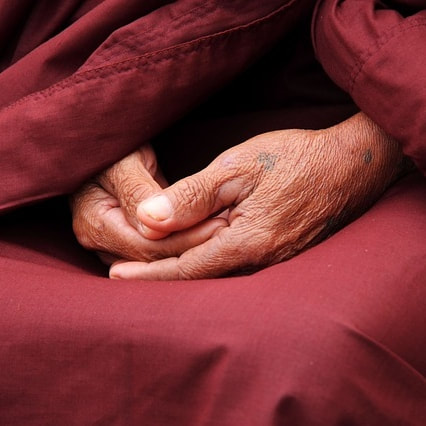
monk
Coptic Monk


Salt Puppet

Once upon a time there was a puppet made of salt who had travelled a long time through dry and desert places until one evening he came upon a sea which he had never before seen and didn't know what it was. The puppet asked the sea: "What are you?" "I am the sea" it replied. "But" the puppet insisted "What is the sea". "I am". "I don't understand" said the puppet made of salt. "I want very much to understand what I can do to know you!"
The sea replied "That's easy, touch me!"
The salt puppet timidly touched the sea with the tip of his toes. At that moment he realized that the sea began to make itself perceptible, but at the same time he noticed the tips of his toes had disappeared. "What have you done to me? he cried to the sea. "You have given a little yourself to understand me" the sea replied.
Slowly the salt puppet began to walk into the sea with great solemnity as though he were about to perform the most important act of his life. The further he moved along, the more he dissolved but at the same time he had the impression that he knew more and more about the sea.
Again and again the puppet asked "What is the sea?" until the wave covered him completely. Just before he was entirely dissolved by the sea he exclaimed:
"I exist!"
Anon (through Rabia)

Salt Puppet in 7 Words as a metaphor for the 7 planes of consciousness

Teaching stories have arisen throughout the world and throughout history as a method to present students—often children of course—with an easily digestible small package of ideas. Typically they can be entertaining; all types of people like to be entertained. Usually they are humorous and often the ‘moral of the story’ is fairly clear. This clear moral however, may not always be the main message. A more subtle understanding can sometimes be teased out, especially if traditional symbolism is included, which is known within the culture that gave rise to the story. This applies to certain of the stories, that are held alive by their entertaining qualities and survive as profound teachings in a hidden, seemingly innocuous form. Tarot Cards are examples of the same principle. We can look at the Salt Puppet story as a way to discuss a Sufi idea to do with the ‘7 Planes of Consciousness’, the teaching that inspired the 7 words.

The first of the 7 Planes of Consciousness unfolds as the Earth plane. This is the lowest grade of light, the slowest. It is perceived through the 5 normal senses as the physical universe. The word No is used to represent the fundamental reality here on Earth—that no two objects can occupy the same space at the same time. Things are necessarily defined—and what defines their identity is a physical boundary. Every aspect of all realities is mirrored on Earth, so there is tremendous richness in form, each type realizing an idea and examining the truth of that idea. Everything is one thing or another—so choice has to develop and so do patience, perseverance and steadiness. Out of these qualities, the personality grows more beautiful and develops mastery as it attempts to find balance and rules for living that help to provide for nourishment and protection.

Once upon a time there was a puppet made of salt who had travelled a long time through dry and desert places…
The realm of time necessarily refers to the Earth plane because it is the only one where time is experienced as sequential and historical. The puppet image is of an unreal caricature whose movements are rigid and dependent upon external forces for motivation—the metaphor of an ordinary person. The salt indicates that the person is dry and can only survive in this form by staying in the desert, with its lifeless imagery.

The 2nd plane is called the Astral and is described as the psychic realm. It relates to our thoughts and emotions. Here the waves of vibration (of light) are experienced in the mind as thought and imagination, dreams and intuition. It is very creative and playful realm where freedom, mischief and fun are more the norm. When we are more in tune with this level of vibration, we delight in making up new ways to do things, especially to solve problems or be artistic. It is here that we experience resourcefulness, genius, intuition, talents, clarity, the understanding of others’ emotions and views. Our sub-conscious desires sometimes surprise us by popping out willy-nilly. People like Peter Sellers and Mozart are typical of this plane—‘djinn spirits’ for whom routines and committed relationships are difficult and whose genius offsets their social ineptitude.

…until one evening he came upon a sea which he had never before seen and didn’t know what it was. The puppet asked the sea: ‘What are you?’
The astral realm contains the sense of following intuition just for the sake of curiosity and without minding whether it’s right or wrong—because the djinn spirit is careless and carefree. Our salt puppet—at evening time, just before night befalls him—has followed his intuition and found something entirely new to play with. He’s curious and asks ‘what are you?’ (not ‘who are you?’). This is the Hello stage.

The 3rd plane is known as the Angelic Realm, the plane of Love, Harmony and Beauty. Love is beyond mind; it obeys its own laws and is not constrained by logic or ideas. It feels in the heart. To access this vibrational level we look for joyful beauty, subtle gentleness—which we see in flowers, trees and landscapes, artistic expression of harmony, the watery sensitivity of relationship and the practice of compassion. We appreciate the value of things and give of the heart in response to these feelings. It equates to Thank You.

‘I am the sea’ it replied ‘But’ the puppet insisted ‘What is the sea.’ ‘I am.’ ‘I don’t understand’ said the puppet made of salt ‘I want very much to understand what I can do to know you!’ The sea replied ‘That’s easy, touch me!’ the salt puppet timidly touched the sea with the tip of his toes.
The sea was identified at first only verbally—appearing therefore only to the mind of the salt puppet, who persistently attempts to engage in a shallow relationship—and yet felt frustrated by his inadequate level of knowledge. He asks for guidance and receives an instruction that is new to him—he has never been asked to touch water before. He feels timid now because he’s on unfamiliar territory—as we all do when we are overtaken by the heart of love. He touches another—with an exquisite sensitivity and sense of crossing a line that may not later be re-crossed.

The 4th plane has a lot to do with crossing the line. It’s called Heroic plane and is associated with masters saints and prophets—types like Jean d’Arc, Gandhi, Alexander the Great, Martin Luther King and thousand others who had no willingness to compromise. It is accessed through the practice of truth—no bargaining with your soul. Christ certainly had a 4th plane aspect—turning over the moneylenders’ tables in the temple. Qualities associated here are fiery conviction, missions, strength of character, power, faith, will, transformation, struggle, mastery, confronting injustice—and eventually surrender to divine will, wisdom and the ability to balance forces. It is the Goodbye vibration—realization, decision, completion and moving on.

At that moment he realized that the sea began to make itself perceptible, but at the same time he noticed the tips of his toes had disappeared. ‘What have you done to me? he cried to the sea. ‘You have given a little yourself to understand me’ the sea replied
A real moment of truth—the instant of realization, the arising of an inner force—that could easily have been expressed as anger or violent rejection—but which is confronted within oneself instead. The need for instantaneous decision and the movement into the unknown. There’s a profound sense of the release of childishness as adult wisdom unfolds with a depth of personal responsibility. Rites of passage are 4th plane.

The 5th Plane is called the Plane of Splendour. It has associations with knowledge of perfection, sacredness, excellence, praise, prayer, cathedrals, glorification, peacefulness, Goddess in Nature, self-respect, dignity, chanting, rituals, majesty, bringing God into life—the priestly vibration. The word Please is enacted within this atmosphere of wanting to bring a sacred vision to Earth.

Slowly the salt puppet began to walk into the sea with great solemnity as though he were about to perform the most important act of his life. The further he moved along, the more he dissolved but at the same time he had the impression that he knew more and more about the sea.
The solemnity of his gestures, the walk of dignity, the sense of fulfilling the soul’s act—the most important ever—are clues of his inner state of great reverence. The salt puppet has come to know that, for him at least, the sea is God, here on Earth. He wants this now, like never before. Having touched God, nothing else will do, the world begins to disappear, the self begins to disappear.

The 6th plane is known as the Immaculate State. Its access is through forgiveness. ‘Life is lived fully only when one feels free to die.’ Purification, purity, hope, rebirth after the despair of despoilment, soul’s innocence, pure light of consciousness, desire for perfection, indifference to other desires, no interests, detachment. Holy Spirit. The word Sorry is truly said to engender a state of forgiveness and brings about refinement of the individual, a sense of egolessness. (That is why it’s so difficult for so many of us to say it sincerely.)

Again and again the puppet asked ‘What is the sea?’ until the wave covered him completely.
Even though the sea is salty, its essential nature is not salt; similarly the puppet’s essential nature is not lifeless salt, in isolation. There is a deeper truth within the ocean of God. Drawn by a something in the briny sea that it senses is akin to itself, yet infinitely greater, it has to lose all of its imperfections—those unyielding aspects that he had come to love passionately as self—and unite with a greater being to lose itself in the ocean of spirit in order to go forward into God. Sufis call this fana (effacement).

The 7th Plane is transcendental—beyond all phenomena and beyond description.
Just before he was entirely dissolved by the sea he exclaimed: ‘I exist!’

The story of the Salt Puppet ends with the two words ‘I exist’. In the beginning, his identity was established and appeared incorruptible because the dry desert—a place lifeless and without the greening of water—was safe. He knew nothing of water, and was curious to find out—so he risked his toe. He then knew of surrender, and equally he knew of the sea. Choosing the mystic life, he undertook an act of great sacredness and gave up his primary attachment, his physicality, in order to gain knowledge of God, which the sea here symbolizes. Quite by surprise and without any previous expectation or hope he discovers existence is not what he had thought before—and now he has it! I exist!

Are we willing to risk a toe in order to discover for ourselves whether existence is not quite how we thought it to be? The journey from No to Yes begins and ends with identity: ‘I exist!’ Perhaps the emphasis has changed now, whereas in No we were proudly proclaiming ‘I’, now we are more humbly acknowledging ‘exist’.

Back to Essays List


Sound and Tone Magic

(From: Magic of Tone… Dane Rudhyar Shambhala 0-394-70887-3)

Sound is a release of creative power. The source of a sound must be elastic and exist in a state of tension because sound is the oscillation of two equal and opposite forces operating upon one another. In order to move out, sound is transmitted by pressure waves and needs a physical medium; this is usually air, though it can be water or solid. Sound requires energy to drive the vibration and to emit from source to destination.

Sound is evidence of will and refers to the operation of creative will. Sound precipitates the Divine Will into form. Will is the force behind sound, directing energy to vibrate matter from which sound arises. Both sound and will are neutral in character and take on the character of that which lies behind the will and expresses through and within the sound.

We desire. What we desire reflects our needs. Our needs can be biological, psychological or mental (ideas seeking realization).

God's desire to create Creation is expressed so: God said, "Let there be Light". In Aramaic Christianity this is "Nurkun". In Sufism this is "Kun Kalam". There is no word more powerful to a Sufi than "Kun"; it is the first impulse, the first release of the Essential Creative Power. The first result of Sound is Light.

Desire lies behind will. Will and Sound are carrier waves, or vehicles to bring into being our desires. What they carry gives them character involving implicit purpose and latent meaning. It is this character which gives the quality of Tone to Sound.

Tone is more than sound because it carries intent and purpose. Sound can be used to create or destroy; it depends upon its tone. Tone implies that tension exists, it means potency and is a medium of magic. Tone is sound carrying meaning.

Because matter is the lowest aspect of being, it has to be moved by higher forces. Such a force is Sound. Sound vibrates matter on a molecular level and its effect upon its destination is audible sound, which we call sound. Hindus know this as Ahatta, whereas the inaudible spiritual Sound is called Anahatta. It is the effect of Anahatta upon matter to make vortices of motion such as atoms and planets spin eternally. (Light vibrates on an atomic level and when we see the effect of Light upon its destination and call this light. Light is a symbol for consciousness. That which is made conscious illuminates the mind.)

Biologically, Sound powers human nerve activity as an expression of will. Will can be unconscious (instinct), or conscious (determination). There is also a condition of human will that is able to arouse movement and this can be conscious or unconscious and this is emotion ("moving out").

Music arouses emotions. Different Musical Scales are archetypes. They express different qualities of the sounds they organise, thus embodying different facets of God's Essential character and capable of motivating beings in various ways.

The essential tension is that existing between Spirit and Matter, between Unity and Diversity. The Universe is the product of the creative release of power made by this tension; this is Sound, carrying the Intent and Purpose of the Divine Idea to express Essence. This Sound is Aum, or Hu, the Tone of One Life, the One.

Although its manifestation at first seems chaotic, as one grows in consciousness one sees more and more of the pattern of existence, a pattern of cycles arising according to the waxing and waning of the two primal states of Matter and Spirit.

When we are using Music consciously to arouse emotions, we are operating a form of Tone-Magic. We approach the tone as we would approach a lover, knowing that the attitude is equally important as the act of making the sound. The act of making love is less profound if attitude is hurried and so it is with music. We offer our music with awareness of our intent, with sensitivity to our emotional state and with reverence for the power of God that flows through us in the sacred act of giving sound expression to the Divine Will.

Back to Essays List


Truth

Perhaps only a very few times in life are we confronted with a moment of Truth.

Can we imagine being face to face with a completely all-seeing, all-forgiving God and asked these questions:

· What do you most desire?
· What do you fear?
· What have done which shames you most?
· What are your secret ambitions?
· Given complete freedom and no judgments against you - what would you like to do?

What is real in my life - the actuality beyond all self-delusion and confusion.
Who am I beneath all of that—the power and the glory of my eternal being?
What would I die for?
What do I live for?

Back to Essays List


Adab – Right Manner

The arising of the subtle knowledge of Sufism is not only dependent upon a teacher who knows, it also reflects the manner of the student; the thirst of the student being an aspect of the teaching, without which nothing can be communicated. In order to learn how to learn the student is encouraged in certain practices, and these prepare the atmosphere of the student so that the teacher is best able to respond to the student’s inner longing. The teacher is also a student – firstly to his/her own guide – later to the Spirit of Guidance.

Examples of practices in Adab

  • Gentleness of disposition, modesty and sensitivity
  • Integrity and dignity in ones interactions
  • Appropriate communication with fellows (confidentiality, no gossiping etc)
  • Taking initiatives to promote the temple atmosphere: tidying, cleaning, switching off lights, beautifying space and self, lighting candles….
  • An oblique attitude towards the teacher
  • Punctuality
  • Correct dealings with money

Back to Essays List


Soul and Ego

There is -and always will be- a tension between soul and ego. Each educates the other. If soul is to develop closeness to realization of God then it needs to smooth the contours of its individuality and find perfect harmony with other souls. Is this not also true of ego? Surely one reflects the other on earth as it is in heaven.

We students of Sufism are learning the dance of soul and ego. At times we connect more closely with soul: on retreat and in our practices, and later we have to reengage more fully with worldly things; we struggle to keep faith with the soul as the ego firms its boundaries against the invasiveness of the grosser materiality of existence.

As souls we yearned with great passion to incarnate and to take up the challenge that angels do not dare to try. As souls we chose to accept the burden of material existence, perhaps not fully aware of how difficult it would be; yet all souls who come to earth are heroes to incarnate.

Our task is to develop a strong and beautiful ego whose dialogue with soul is constant and real. Through this we learn to rise above the lowest aspects of life and to spread the Message of God in all we do.

As we learn, we teach. As we are healed, we heal. Also Teaching and Healing are one. As we teach, we heal; as we heal, we learn. This is service (Abdullah). This is the expression of ego and soul dancing together the Message.

Our work in Sufism is to focus on Teaching, Healing and to celebrate the truth of God’s presence.

Back to Essays List


I Wonder

At the river
I pray for You to show Yourself
Yet I see nothing but a stork gliding its joy
And a million petals of light
On the windswept water
Dazzling me blind
All I hear are crickets and leaves
And a woodpecker's absurd knocking

I reach out to the tiny strawberries sprinkled about me
Then, delighting in the sensation of taste
I wonder
I wonder why I love You so much
When you never answer my prayers

Back to Essays List


The essays that follow can be used in combination with the wazifa walks to form a teaching session for Sufi oriented dance leaders

Transition

We continually move from what was towards what will be – ever in a state of transition. As seekers, we view this as opportunity to improve ourselves, by releasing inappropriate states in order to make space for a renewal to occur. The first stage must surely be to identify such unwanted states, and these are shown to us by the Divine dispensation of Ya Darr – the harmful one, the Distresser – which let us become aware of what is to be changed. (Root dar: darvish, darood – doorsill between this world and the next). With guidance – Ya Rashid, Unerring Guide – we can redirect the power of mind towards nature’s way and affirm our faith by witnessing ourselves through God’s eyes. (Relates to Shahid, witness)
Further reaffirming our clear intention to move through distress to a healed state, we ask for God’s help knowing that our prayers are answered: Ya Mujib – the one who hears our prayers – and then arrive at Ya Muhyi, the revitalised condition of embodied life force. (Mu – embodiment, Hayy – life).

Back to Essays List


Die before you Die

The Sufi idea to ‘die before you die’ is the quintessence of mysticism. That which dies is the nafs, or false self, and it struggles with all its ego-centric power to avoid annihilation in fear of oblivion. However, if within this lifetime we are able to negate our attachment to the small self, then we will allow the greater Self to shine—the soul's light manifesting in the physical—the highest achievement of the Sufi or any seeker.

The sequence of walks begins with Mu’id—the Restorer—to bring new life energy and vitalize us in preparation for the great task. This dying is not the default process of a sickening being; it is quite the opposite. Muhyi—the Quickener—completes the process of infusing the body with life force.

Then comes Mumit—death—the end of all processes, the final curtain.

We continue by awakening into new life—Hayy!—and complete with Qayyum—Resurrection—reborn into Unity.

In a very real sense we can face our own mortality with the same degree of watchfulness and witnessing as we would on beginning a retreat—neither complacent nor overwhelmed and emotional. Having died to all earthly attachments, we're ready for the journey across the Great Divide.

Back to Essays List


Incarnation

Incarnation can be studied as a journey of the soul through stages that are suggested by divine qualities.

In the time before time, there was no movement, as Spirit had not identified itself in vibration, all was stillness. We cannot reach but only approach this condition – since ultimately stillness is the beginning and the end of all life – and so we may tune into this within the practice Ya Salaam. There is no purpose, no restlessness and no opinion in this timeless practice; we observe the most sublime sense of being held as the centre of God’s Heart.

Bursting out with the explosive vigour of a volcano, the power of God is interpreted by scientists as the Big Bang – the ultimate force that gave rise to Creation and continues to empower all vitality. Ya Qadr. It is felt in the atmosphere of a tiger: focused now and with a specific goal it stalks its intended object with awesome intensity and certainty.

Such focus leads towards realization and the manifestation of form of the exact definition of the inner truth, our closet grasp of the ultimate Truth, Ya Haqq. It is what is, without dilution or embarrassment, unambiguous fact beyond all debate or negotiation, a clear statement of our spiritual station.

Though our truth is primary, we also are shown how to reach out with love, soft and gentle in relating to others. Ya Rahim enables the receptive aspect so that we have a sense of how best to radiate with compassion towards those in need of kind attention; it is sensitive to the suffering of those unable to remember the Source.

To remember the One who has created life, is creating life and always will create life, we affirm our vitality as an aspect of God’s undiminished ever-flowing vibration of life-force around us. Ya Hayy! We exist as an aspect of God’s creative urge in order to create and explore possibilities so that Creator may know itself through the eyes of Creation

Back to Essays List


Wisdom                                                                            

The sword of St Michael cuts away anything false from the heart – Ya Haqq – and brings us ever deeper into a place where no compromise is known. Yet by a process of expanding our sense of what is real – Ya Basit – we grow beyond the limited sense that truth is hard and fixed. Ya Wasi is the furthest reach of this, beyond all limits, a place where somehow all relative truths are contained into a sense of the Absolute. Rahim’s gift is of sensitivity and attunement to another’s truth, a softer compassionate perception that enables the hardness of Haqq to take on a more human quality of Hakim – the affirming that when balanced with compassion, Truth becomes Wisdom.

Back to Essays List


Faith                                                              

With faith, the seeker can call upon an additional dimension of strength and with absolute faith, absolutely anything is possible. According to Hazrat Inayat Khan there is no difference between faith in God and self-confidence.
With Sabur, we learn the lessons of patience. Even though our progress is stalled and frustrated, we simply keep on going, trusting that forbearance and holding an inner light will lead to more trust.
Mu’min is the embodiment of trust – Amin. I have faith, I am faithful, I guard the faith, you, can trust on me to be trustworthy.
Matin – a simple straightforward plodding kind of motion, untiring, deliberate and firm of purpose, born out of doubtlessness.
Mansur – one name given to the Prophet to convey the sense that develops out of faith – of one triumphant in all the words, fortified by the Archangel Gabriel and by God.
Faith may begin cautiously yet it, grows and flowers as its power becomes blatant and incontrovertible – to a glorious triumphant knowledge that one can only ever serve God and be victorious.

Back to Essays List


Spiritual Journey                                                      

The journey we are on is a process through which we strive to know God, in the hope that God’s Divine Knowledge Alim then expresses itself as us – at least an aspect of it. The world of our experience is a particular facet of God through which both we and the Omniscient Being gain deeper awareness.
With guidance, Hadi, we develop our sense of right direction. This can perhaps appear to us inwardly as the archetype Khidr – the ‘Green Man of the desert’ – who leads us towards Truth when we digress. Such teaching can also take outer form as an embodied guide, which is a central aspect of the Sufi path and helps us to stay focused clearly and honestly upon our avowed spiritual purpose.
Spiritual awakening necessarily involves emotional process, and occasionally overwhelmingly difficult life challenges. Wakil is the guardian angel who is ever-present and always there when we need comfort and support so that we are carried through the ‘bad times’ until we’re able again to attend to our chosen work.
As-Salaam is the end of our toil, the perfection of peace, the natural condition at the end of all restlessness.

This series of walks is particularly refined and requires a measure of preparation in order to hold the attunement. Alim is almost tuneless and so requires the leader to create and hold the appropriate atmosphere throughout the whole practice. Hadi demands a very good level of concentration. Wakil is sweet and self-nurturing – a favourite melody – and Salaam is, of course, very inward and still, so needs time in silence to complete.

Back to Essays List


Worship                                                                       

The word for mosque is Jāmi' – its where energy is gathered together with a very clear alignment – everyone who conjoins has the same agenda so that a build up can take place and added value is achieved. Jāmi' has a long first vowel and a clipped second. The energy builds, much like a number of people congregating, until a precious collective state forms simply out of the act of gathering.
Within the congregation of Sufis – some 40 million world-wide – there exists much that is similar and much that is special to particular groups. Those following Hazrat Inayat Khan will probably tend to be able to tune in to his tenderness. Inayat as wazifa promotes this quality – a blend of strength and gentleness. One could use the image of Joseph – the male who serves the female.
By whatever method we worship, we become more available to embody the Divine Light of Nur. It takes many forms – the light of Truth, the light of Intelligence, visible light and so on – and yet within all forms of light Nur is the quintessential Divine Light that is God, through which we come to have knowledge of Unity.
As we embody these various archetypal states, we grow in awareness of ourselves as aspects and expressions of God’s magnificence. The soul exalts in knowledge of itself as a part of this glory. Dhull Jelal wal Ikram and its sister Khanun Jamil wal Ikram are powerful – even overpowering – swellings of abundance that can wash over us or carry us as surfers on the wave of Absolute Splendour.
This study of Worship leads us through the strait gate of congregation towards the wild glory of Divine Splendour and Majesty through the gentleness of care and with extreme sensitivity of Light. It is a celebration of community that dances between the male and female polarities.

Back to Essays List


Clarity                                                                            

According to Ibn ‘Arabi ‘knowledge veils the Known’. Clarity helps to pierce the obscuration – how thick is the veil? Language can hide knowledge as much as it can illuminate it – as much as a mind can be foggy or clear.
Alim is the mind of God, Divine Intelligence, Absolute Knowledge. How can we touch the relationship between cause and effect without this? How can we grasp the patterns inherent and hidden in all life, unless we have God’s mind?
Khabir unfolds a degree of awareness that may allow us to contemplate the possibility -  that we are unable to determine our own degree of clarity with mind alone. By thought we cannot overcome thought!
We invoke more light – Essential Light – Nur. Nur is beyond all concepts, beyond all ideas of God, and illuminates from within.
Sabur helps to overcome the effect of emotions upon the operation of mind by the mastering of impatience – which itself influences the clarity of our thoughts.
Mubin is divine clarity; the explainer/the distinguisher, a test of our understanding.  Can we explain ourselves?  We may have awareness, but can we explain it?  Can we explain who we are in our words and behaviours?  We are all facets of God.  The principle quality which distinguishes us is Mubin.  Yet what we feel we are is different from whom we are.  Self-image is subject to correction.

Back to Essays List


Openness

Openness is an aspect of God and a requirement for the disciple.

In early life we all suffered a constant background of energy that offended our sensitivity, and so to protect ourselves from hurt and harm, we defended by closing our receptive nature against the intrusions. This was appropriate and important to our survival and yet also it was damaging to our psyche.
Now we are repairing this damage. We do this by becoming open to some of these offending energies and yet we are capable of affirming positive qualities as we open. We have strength of will and strength of mind to persist even when the pain seems intolerable. It is not less painful now; it is simply less overwhelming because we are more conscious and emotionally mature.

To break the crust of our resistance, we need a sharp concentration of clear intent. Ya Fatah.
To develop a true perception of ones own perspective on life and to open inner awareness. Ya Batin.
To transform the pain of separation into a yearning to be beautiful in God’s eyes. Ishq Jamil.
To surrender completely, to be one with the One. Hu.

Back to Essays List


Group Process

Group Process is a Sufi practice as important as the other practices. The harmony of a group requires that all members are involved with the emotional process of everyone else with an attitude of peace (Salaam) and forgiveness (Ghafur). We can feel the release of tension in the body and this releases tension in the emotions and helps us to allow congested emotional energy to find equilibrium. Since God is One, the closer we get to realising God the more we realise that another’s emotional attitude is a reflection of our own and that healing ourselves and healing others is the same thing.

Any developing community goes through 4 stages:

  1. Distance and lack of openness
  2. False community when people pretend to be always in harmony
  3. Breakdown of the false harmony into chaos and shadow
  4. Honest inter-relating, the foundation of true community.


Back to Essays List